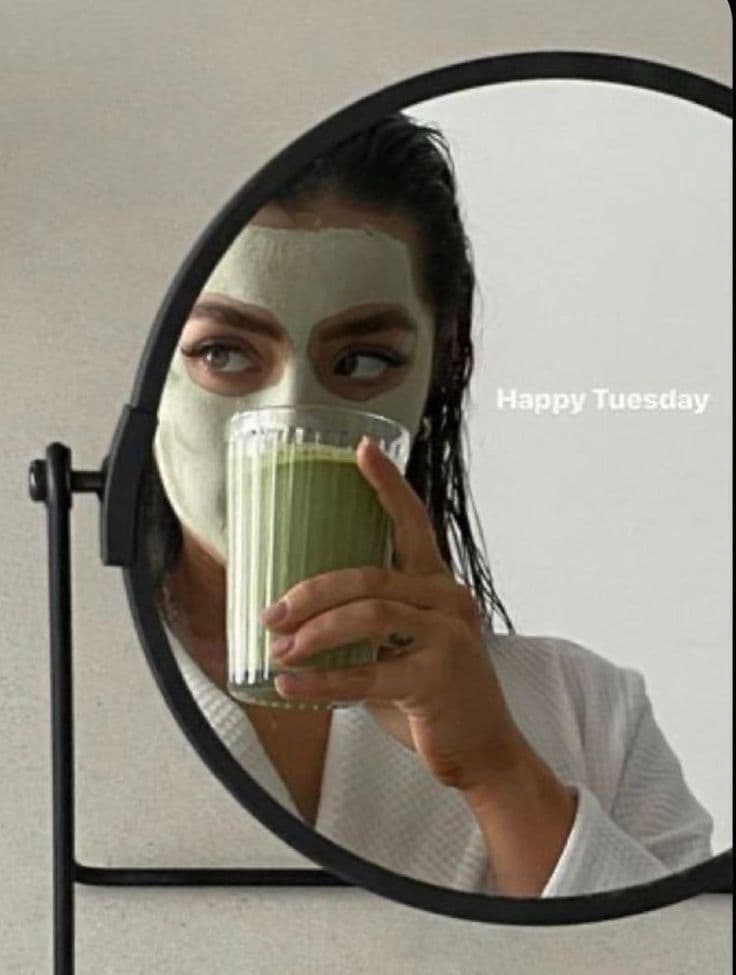

Beauty trends come and go, but some have a greater impact on how people behave, how they look, what they consume, and what they value. The "Clean Girl" aesthetic, which emerged in early 2022, is one such movement, but it is more than just a passing fad. It is a complete theology, a modern-day beauty religion that preaches minimalism while demanding maximum effort. She is flawlessly polished, yet never overdone. She glows without makeup, yet her skincare routine costs more than some people's rent. Her outfit is basic, understated, and tailored for the kind of woman who never looks like she’s trying too hard—because trying too hard is the ultimate sin in the religion of effortless beauty. The Clean Girl doesn’t just represent a look; she represents a whole culture in which wellness is a status symbol, restraint is glorified, and perfection must appear completely natural.
At first look, the Clean Girl aesthetic seems innocuous. What could be so wrong about looking fresh-faced and polished? But, as with all beauty trends, the devil is in the details. The Clean Girl is not just about being neat and put-together—she exudes a sense of quiet luxury, with a lifestyle so well-manicured that it never slips into chaos. The Clean Girl gets up early, drinks lemon water before speaking with anyone, practices morning affirmations, and devotes time to skincare rituals that promise to "enhance" rather than "conceal." She has perfected the art of self-improvement, but she will never admit she is working at it. This is the paradox: the Clean Girl aesthetic necessitates meticulous care while demonstrating that maintenance is unacceptable. Unlike the glam-heavy trends of the early 2010s, which openly celebrated transformation, this new gospel demands perfection that appears effortless.
The aesthetic's appeal stems from its exclusivity. On the surface, it appears like anyone can have the Clean Girl look—all you need is a slicked-back bun, a white linen shirt, and a little lip gloss, right? But in reality, the aesthetic is inextricably linked to privilege. A true Clean Girl does not simply wear minimalist gold hoops; she wears expensive minimalist gold hoops. She not only has clear skin, but she also has access to dermatologists, treatments, and high-end products that make clear skin possible. Her seemingly effortless beauty is, in fact, a full-time profession — one that demands time, money, and social capital. And herein lies the problem: the Clean Girl aesthetic presents itself as an attainable lifestyle while quietly ensuring that only a select few can truly embody it.
The Clean Girl movement, like all religions, has its saints; a selected group of followers, and they tend to have a distinct appearance. The most apparent examples of this aesthetic are overwhelmingly thin, light-skinned (specifically white), and conventionally attractive. While people of all races and colors participate in the movement, the most extreme version of the Clean Girl—what social media platforms reward the most—leans towards a Eurocentric standard of beauty. A white woman in a sleek bun is "chic"; a Black woman in the same style is sometimes viewed as "trying too hard". The Clean Girl, despite her minimalist philosophy, is not neutral—she is yet another iteration of beauty that favors a specific kind of look, a specific kind of girl.
In light of these discrepancies, Raquel, a 21-year-old LIM College student, accused Hailey Bieber of copying a culturally significant style with her "brownie glazed lip" trend on TikTok. She said,
“It is ignorance in the sense that she made it seem as if this were a new trend when she tinted her lips due to lack of melanin” (source: Lexington Line 2023)https://www.thelexingtonline.com/blog/2022/12/8/dirty-discourse-the-clean-girl-aesthetic-was-co-oped-from-people-of-color
Similarly, Nena Lezama, writing for Hip Latina, said:
“I remember working at the tech giant, feeling like I needed to swap my hoops for diamond studs and trade my curls for straight, tamed (clean) hairstyles”
She went on to say:
“It wasn’t until recently that the same fashion and beauty rocked by Black and brown girls finally became accepted because it was worn by more ‘socially accepted’ kids”
This level of frustration is not uncommon. For years, many women of colour have been criticized and shamed for expressing their beauty in ways that are now adopted by white influencers. The slicked-back bun, the minimum makeup look, and the "brownie glazed lips"—these characteristics, which were once linked with femininity in communities of colour, are now acclaimed as “effortlessly chic” when worn by white influencers. However, when women of colour wear these same styles, they are sometimes labelled as "trying too hard," "ghetto," or "too much." This inconsistency not only reflects racial dynamics within beauty standards, but also a broader cultural appropriation issue — where practices and looks originating from marginalized communities are commodified and rebranded when taken on by individuals in more privileged positions
Despite its exclusivity, the Clean Girl aesthetic is not invincible. Every beauty trends has its highs and lows, and the flaws in this one are already showing. People are pushing back against the pressure to look perfect at all times. They are calling out the classism, colourism, racism, and even fatophobia baked into the aesthetic. They are questioning if the pursuit of "natural beauty" is just another way to make women feel like they're never doing enough. When a trend becomes too inflexible or unrealistic, it inevitably collapses under its own weight. The Clean Girl's reign will not last forever, just like every other beauty trend.
The gospel of glow continues to spread, influencing everything from beauty marketing to wellness culture. Brands have capitalized on the aesthetic, selling everything from "clean" skincare to barely-there makeup that promises to enhance rather than cover. The Clean Girl is the ideal customer because she is constantly striving for an unattainable goal— always needing just one more serum, one more sculpting tool, one more wellness hack to keep her shine. And, in an age where social media blurs the line between lifestyle and identity, the pressure to conform to this aesthetic is relentless. It's no longer just about looking nice for an event or a nights out; it's about being camera-ready at all times, ready to glow effortlessly under any lighting, on any platform.
Perhaps the only way to truly break free from the Clean Girl's grip is to recognize it for what it is: a skilfully crafted fiction rather than a personal weakness or a lack of discipline. It is a performance that few can sustain without burning out. The Clean Girl may appear to have it all together, but behind every effortlessly slicked-back bun is someone making sure not a single strand is out of place. And behind every dewy, natural glow is an entire industry profiting off the fear of being viewed as anything less than flawless. The Clean Girl might be the reigning beauty ideal for now, but the most radical thing anyone can do is to simply quit chasing her altogether.